A New Report Examines Women’s Access to Positions of Power in the UN and the Multilateral System Since 1945
Share
- The fourth edition of the Women in Multilateralism Report presents the complete record of candidacies for the UN Secretary-General since 1945: 48 men, 8 women, and no woman elected in eight decades.
- Women currently lead 46% of the multilateral organizations analyzed, but remain well below parity in governing bodies and in UN Permanent Representations, where they account for 23%.
- Since 1947, 20 UN General Assemblies have taken place without a single woman serving as Permanent Representative, and 72 countries have never appointed a woman to that position.
At a critical moment for the future of multilateralism, marked by the 80th anniversary of the United Nations (UN80) and the upcoming selection of its Secretary-General, a new report by GWL Voices provides unprecedented historical evidence on who has had access—and who has not—to the highest positions of power in the international system.
The fourth edition of the Women in Multilateralism report (WIM26) presents, for the first time, a complete historical record of all known official candidacies for the position of UN Secretary-General since 1945. The analysis reveals that over eight decades, 48 men and only 8 women have been official candidates, and that no woman has ever been elected. During the first six decades of the organization’s existence, no woman was even formally considered for the post.
WIM26 places these findings within a broader analysis of gender representation across the multilateral system. Drawing on data updated to 2025, the report examines 62 international organizations, analyzing four key levels: executive leadership, senior management, governing bodies, and Permanent Representations to the UN.
Although women currently lead 46% of the organizations analyzed, the data reveal a consistent pattern: women’s presence declines significantly in spaces where decision-making power is concentrated. In governing bodies, women hold on average only 29% of seats, and among Permanent Representatives to the UN in New York, they account for just 23%. The report further documents that 72 countries have never appointed a woman as Permanent Representative to the UN, and that since 1947, 20 General Assemblies have been held without the participation of a single woman in that role.
According to the report, these gaps are not due to a lack of qualified women, but rather to structural patterns of exclusion and selection processes that have failed to assess merit equitably. “This is not a debate between gender and merit,” says Susana Malcorra, President and Founder of GWL Voices. “The question is whether merit has been defined and recognized fairly. Highly qualified women have existed for decades; what has been missing is a process that recognizes them without bias.”
The analysis also shows that change is possible. Where progress toward parity has occurred, it has been the result of deliberate decisions: clear targets, systematic measurement, and accountability mechanisms. “The progress we see at some levels of the multilateral system did not happen by inertia,” Malcorra adds. “It was the result of concrete political decisions.”
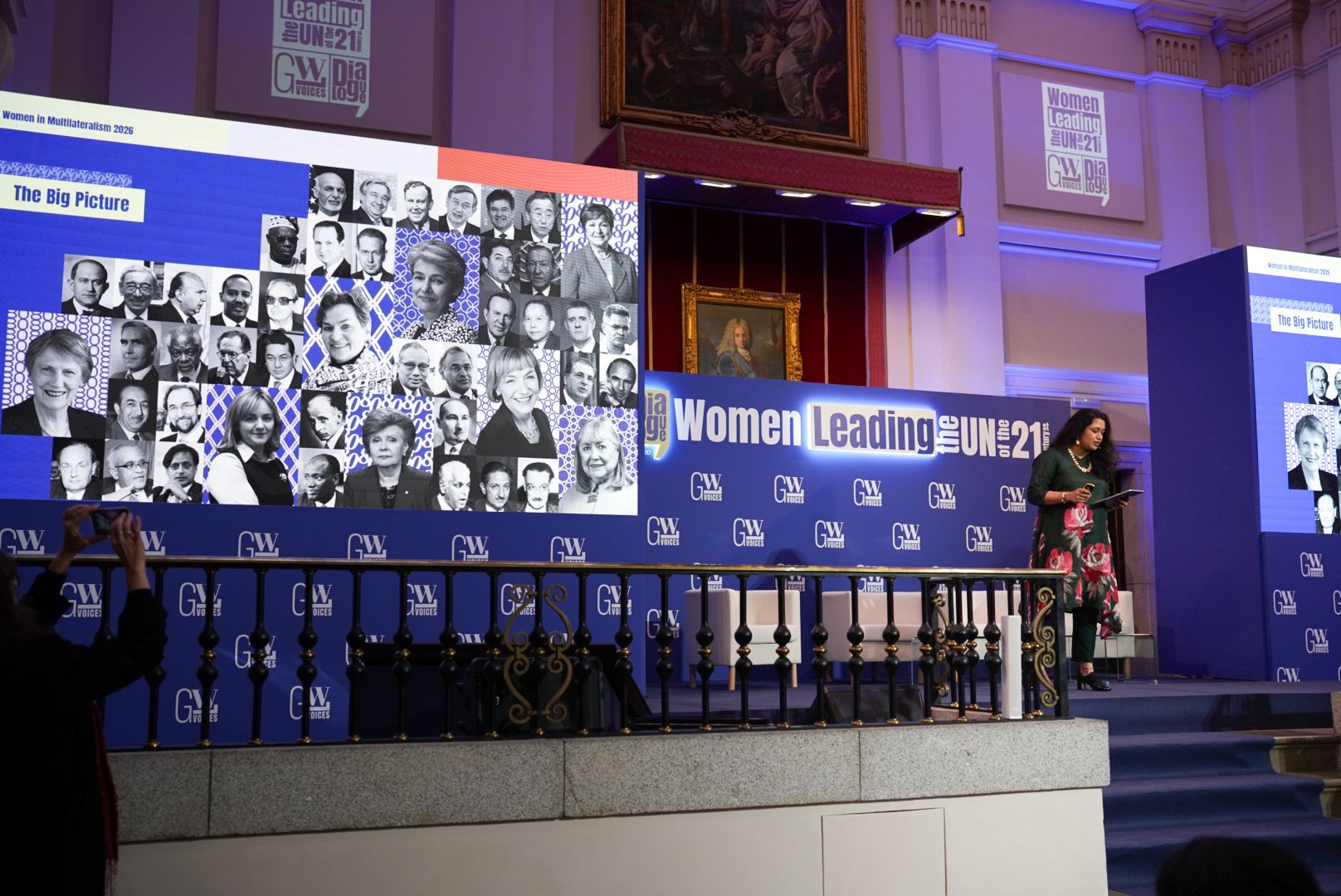
The findings of WIM26 were presented today in Madrid as part of the GWL Voices Dialogue 2026, “Women Leading the UN of the 21st Century,” inaugurated by His Majesty King Felipe VI of Spain. The session was opened with a keynote address by the President of Slovenia, Natasa Pirc Musar. The presentation was delivered by Nudhara Yusuf, Co-Chair of the Coalition for the UN We Need (C4UN), at a gathering that brought together international leaders in a context of growing questioning of the legitimacy and effectiveness of multilateralism. Participants included, among others, Michelle Bachelet, Rebeca Grynspan, María Fernanda Espinosa, Noeleen Heyzer, and Sigrid Kaag, alongside the co-founders of GWL Voices—Susana Malcorra, Helen Clark, and Irina Bokova—former candidates for UN Secretary-General.
In a global landscape marked by geopolitical tensions and growing distrust of international institutions, the report argues that the future legitimacy of multilateralism will depend on its ability to truly reflect all people, beginning at its highest levels of leadership. At this point, WIM26 concludes, the question is no longer whether qualified women exist to occupy these positions, but what continues to prevent their access.