Final Reflections on the GWL Voices Dialogue 2026: Women Leading the UN in the 21st century
Share
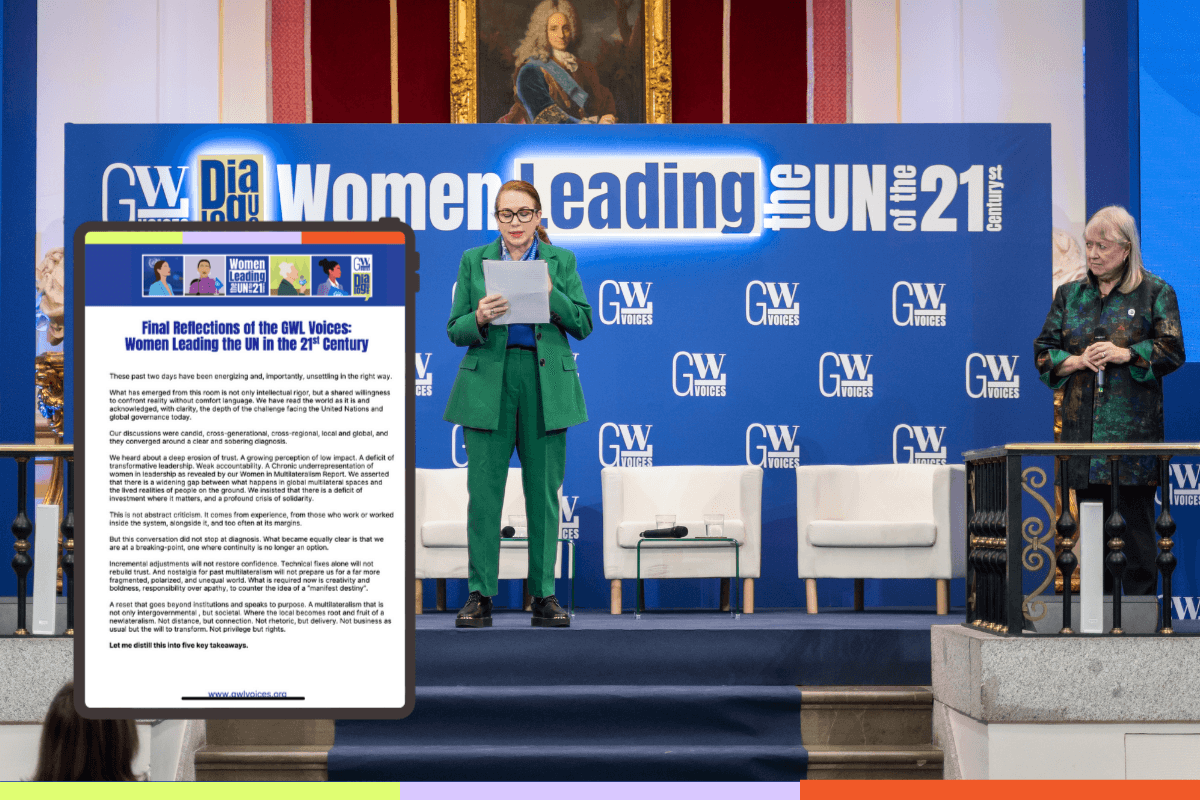
These past two days have been energizing and, importantly, unsettling in the right way.
What has emerged from this room is not only intellectual rigor, but a shared willingness to confront reality without comfort language. We have read the world as it is and acknowledged, with clarity, the depth of the challenge facing the United Nations and global governance today.
Our discussions were candid, cross-generational, cross-regional, local and global, and they converged around a clear and sobering diagnosis.
We heard about a deep erosion of trust. A growing perception of low impact. A deficit of transformative leadership. Weak accountability. A Chronic underrepresentation of women in leadership, as revealed by our Women in Multilateralism Report. We asserted that there is a widening gap between what happens in global multilateral spaces and the lived realities of people on the ground. We insisted that there is a deficit of investment where it matters, and a profound crisis of solidarity.
This is not abstract criticism. It comes from experience, from those who work or worked inside the system, alongside it, and too often at its margins.
But this conversation did not stop at diagnosis. What became equally clear is that we are at a breaking-point, one where continuity is no longer an option.
Incremental adjustments will not restore confidence. Technical fixes alone will not rebuild trust. And nostalgia for past multilateralism will not prepare us for a far more fragmented, polarized, and unequal world. What is required now is creativity and boldness, responsibility over apathy, to counter the idea of a “manifest destiny”.
A reset that goes beyond institutions and speaks to purpose. A multilateralism that is not only intergovernmental , but societal. Where the local becomes root and fruit of a newlateralism. Not distance, but connection. Not rhetoric, but delivery. Not business as usual but the will to transform. Not privilege but rights.
Let me distill this into five key takeaways.
First, context matters. No reform, no leadership agenda, no transformation can succeed without an honest reading of the moment we are in. If the context is misread, the response will inevitably fall short.
Second, narratives and analytics matter. Clarity is not technocratic, it is political. Without accurate data and analysis, without narratives that can touch and be understood by all, and truthful framing, reform risks becoming procedural rather than transformative.
Third, UN80 is inevitable, but largely insufficient. Anniversaries do not transform systems. Without structural change, UN80 risks to be come a moment of reflection rather than renewal. It is an opportunity, but one that requires consensus building and greater ownership from governments.
Fourth, incrementalism is no longer responsible. Band-aid reforms will not rebuild trust. The system must confront overlapping mandates, heavy bureaucracies, wasteful processes, and working cultures that privilege procedure over impact.
Fifth, and critically, leadership is the decisive variable, were women have to be in the driving seat. The upcoming Secretary-General selection is not a routine transition. It is a vital, an existential change that will shape credibility, authority, and direction to the UN.
After 80 years, it is both legitimate and necessary to select a Madam Secretary-General, not as a symbolic milestone, but as a substantive and strategic choice. Not any woman, but a woman with authority and the courage to exercise power in service of change.
This is not a debate about merit. Merit is a given. It has always been. There are so many extraordinarily qualified women out there. It is about the right political choices.When the right woman leads institutions grow stronger and mirror better who they are to serve.
A new multilateralism must ultimately be judged by one simple measure: does it improve people’s lives?
The United Nations remains indispensable. But indispensability cannot be presumed; it must be earned every day through relevance, credibility, and measurable impact.
That responsibility rests, first and foremost, with Member States. It depends on political will and on a shared commitment to build a stronger, more effective, and impact driven international system.
At the same time, citizens and civil society have a critical role to play. The energy and wisdom present in this room make one thing clear: the ideas exist, the talent exists.
Confronted with the gravity of today’s crisis of multilateralism, we hold the power to decide what role -individual or collective- we want to play in this moment of opportunity and transformation.