Share
What do candidates for United Nations Secretary-General choose to talk about when they share the same stage? The London, Geneva and Jeju debates created a public record of how candidates for United Nations Secretary-General chose to describe the institution, the role, and the world it is meant to serve.
At a time when many voices are calling for a reimagining of multilateralism, the debates were strikingly practical. Candidates focused on what the UN should do, deliver and solve. The discussions focused less on symbolic questions, including the prospect of a first woman Secretary-General, and more on the demands facing the institution now.
So what stood out? Below, we unpack the language of the debates: what dominated the conversation and what set candidates apart, without assessing their positions or performance.
The themes that took up space
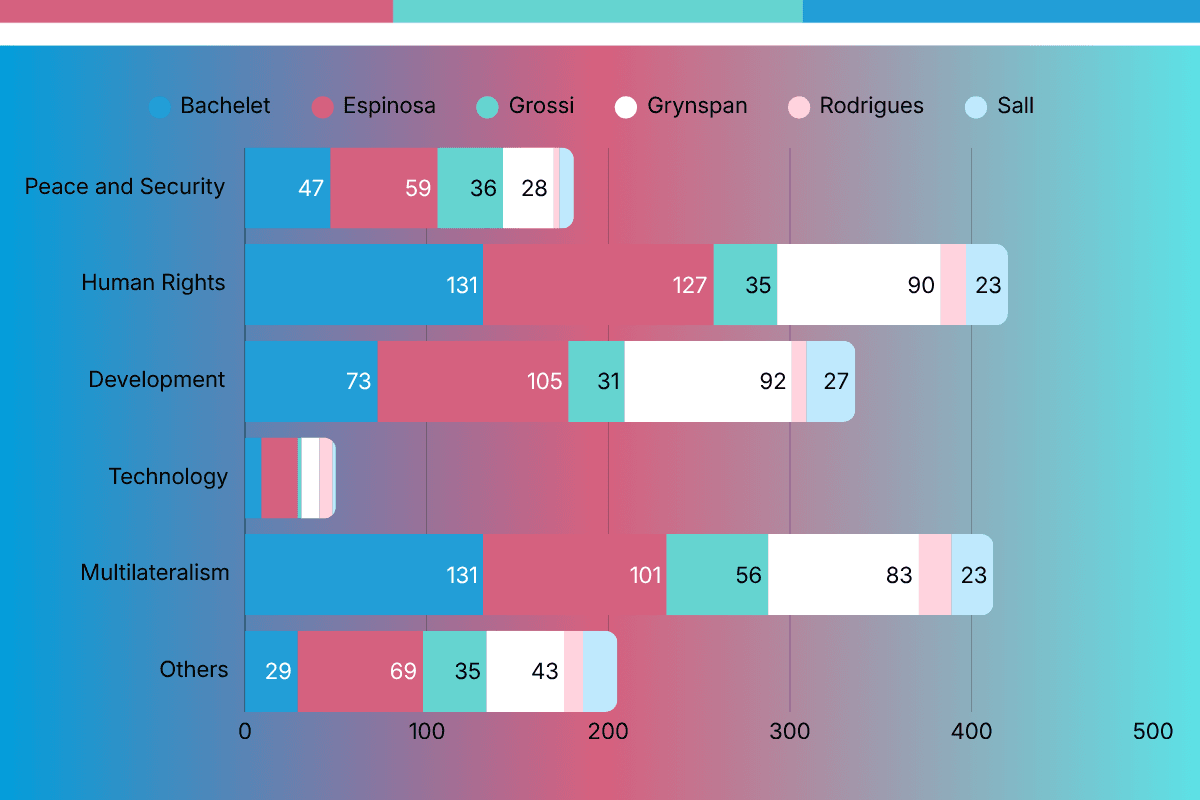
We grouped words and phrases into broader thematic categories. Three correspond to the UN pillars: peace and security, human rights and development. Two capture cross-cutting areas that shaped the debates: multilateralism and technology.
Human rights accounted for the largest share of references, at 26.2%, with multilateralism following closely at 25.7%. Development represented 21%, while peace and security accounted for 11.3% and technology for just over 3%.
The prominence of multilateralism is one of the clearest findings in the analysis. Candidates devoted almost as much attention to the workings and future of the international system as they did to human rights, and more than to development or peace and security. The debates focused both on the issues the UN must address and on the system through which it is expected to address them.
This overall pattern contained some clear differences in emphasis. Looking across the full set of debates, Bachelet made the highest number of references to human rights and multilateralism, Grossi to peace and security, Grynspan to development, and Espinosa to technology. Sall and Rodrigues-Birkett did not record the highest number of mentions in any category, in part because they have participated in fewer public debates so far.
What kept coming back
Some words appeared again and again, regardless of who was speaking.
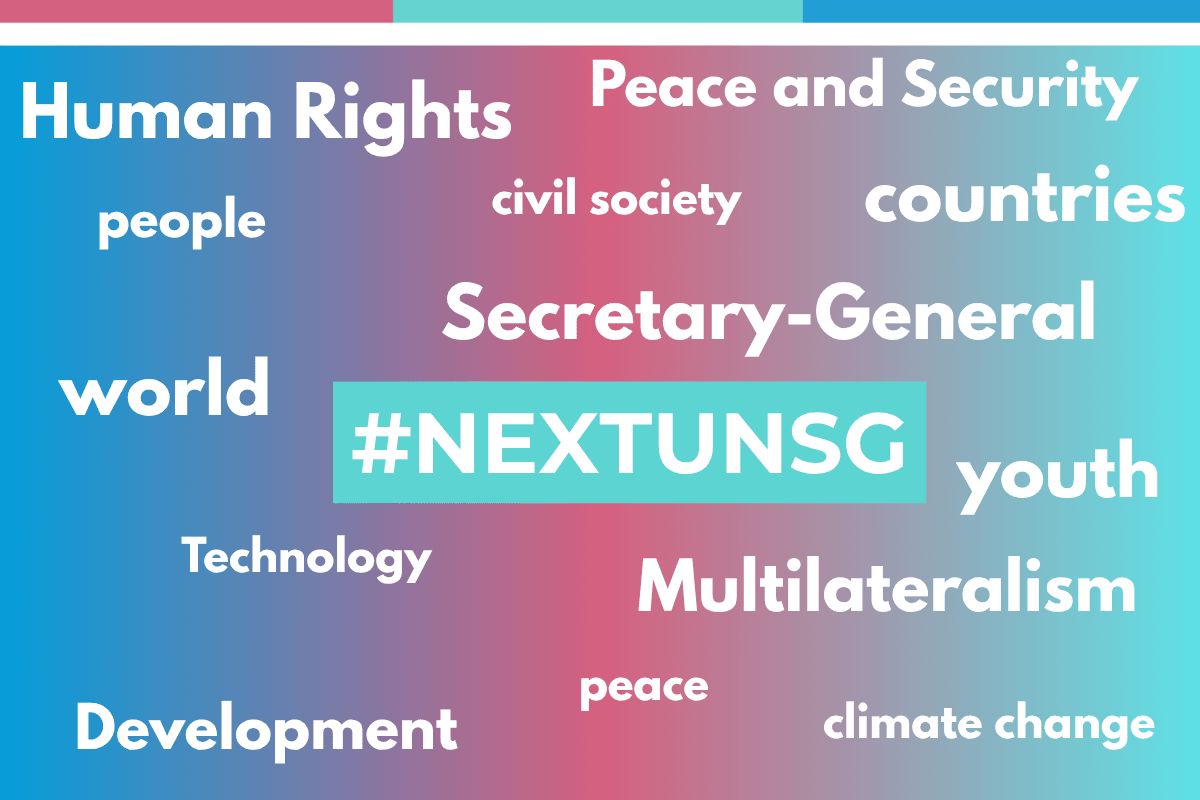
Among the most frequent meaningful terms were Secretary-General (96), people (81), countries (68), human rights (62), world (61), youth (59), development (56), civil society (52), peace (43) and climate change (41).
Gender-related terms were present, but they did not dominate the debates. Women appeared 28 times, gender six times and girls twice, while feminism and feminist did not appear. The office itself was also described overwhelmingly in gender-neutral terms. Of 165 references to the Secretary-General, 139 were neutral and 15 referred to a specific former officeholder. Only six explicitly framed the role as female, principally in interventions by Bachelet and Espinosa. Grossi used the formulation he or she, while Sall used the masculine pronoun in describing the office’s strength. Grynspan and Rodrigues-Birkett did not mark the gender of the office in their references.
The prospect of the first woman Secretary-General was acknowledged, but it did not dominate the debates. The conversations centred primarily on the candidates’ ideas, merits, proposals and interpretations of what the UN system requires at this moment.
Youth appeared among the ten most frequently used words of four candidates, making it one of the most widely shared substantive terms in the dataset. People appeared in the top ten of every candidate except one. Climate change also remained visible throughout the discussions.
The candidates’ individual rankings reveal different points of emphasis. Bachelet’s most frequent terms combined people and human rights with peace and women. Espinosa brought together human rights and development with climate change, youth and the future. Grossi’s list was more closely shaped by the UN, civil society and nuclear weapons. Finance ranked second for Grynspan, alongside youth, people and civil society. Youth was Rodrigues-Birkett’s most frequent substantive term, while reform and artificial intelligence also entered her top ten. Sall’s top-ranking words included sustainable development, culture and children, giving his list a particularly social and development-oriented profile.
The most frequent terms moved constantly between the institution and the people it is meant to serve. References to the Secretary-General, countries and civil society appeared alongside people, world and youth, suggesting that candidates framed the role both through the machinery of the UN and through its effects beyond it.
Alongside institutions and people, peace-related language remained consistently visible throughout the debates. Peace appeared 43 times, compared with 16 mentions of war, while security appeared 34 times compared with conflict, which appeared 27 times.
Where candidates sounded different
The most frequent words show what dominated the debates. Looking instead at the words used by only one candidate reveals where they sounded different. These terms do not necessarily represent each candidate’s principal priorities. Some reflect specific examples or moments, but together they show the references and frames each candidate brought to the conversation.
Bachelet was the only candidate to use words including gender, democracy, girls and humanism. These terms brought questions of representation, rights and political values into her interventions.
Espinosa’s unique words included innovation, transformation, intercultural, infrastructure and Human Rights Council. She combined references to institutional change with questions of inclusion and organisational capacity.
Grossi alone used terms including nuclear, weapons, Iran, Ukraine, Russia and Article 99. His unique vocabulary was particularly closely connected to security and geopolitics.
Grynspan’s unique words included education, multipolarity, development banks, redistribution and planet. She linked development questions with changes in the global economic and political order.
Rodrigues-Birkett’s unique terms included communication and governance. Though her list was shorter, these words pointed towards how institutions organise themselves and explain their work.
Sall was the only candidate to use terms including challenges, coordination, frontier and regional organizations. These references introduced a language of regional cooperation and collective response.
The differences extended beyond vocabulary. Candidates also varied in whom they mentioned during the debates. Most referred to at least one fellow candidate, sometimes acknowledging or building on a previous intervention. Bachelet referred to Espinosa; Espinosa to Grynspan; Grynspan to Espinosa and Bachelet; and Rodrigues-Birkett to Grossi and Espinosa.
Grossi was the exception. He referred to figures including Ban Ki-moon, Volodymyr Zelensky and Vladimir Putin, but did not mention any of his fellow candidates. His references connected the discussion more closely to international figures and events than to the exchanges taking place on stage.
A grammar of doing
Vocabulary and references showed where candidates differed. Their verbs, by contrast, revealed a striking degree of convergence.
The verbs used across the debates suggest an emphasis on action and results: deliver and solve appeared 18 times each, compared with improve (9), facilitate (5), and implement (5).
The most common mental and action verbs reinforced this practical tone. Think appeared 178 times, do 130 times and know 78 times. More speculative or emotional verbs were much less frequent: imagine appeared twice and feel six times.
Relational verbs also appeared repeatedly. Candidates used listen 20 times, agree 19 times and learn 14 times. The language of action was therefore accompanied by a language of exchange: doing, but also listening, learning and finding agreement.
Several smaller contrasts also stand out. Change appeared 21 times, compared with five mentions of maintain, while start appeared 13 times and stop six times.
Taken together, these verbs describe a role framed around execution. The next Secretary-General is expected to interpret a difficult global context, while also acting within it: delivering, solving, listening and building agreement.
The debates therefore offer a particular picture of the race so far. The candidates converged on numerous issues, but differed in the themes they emphasised and the references they brought into the conversation. Across those differences, the dominant language was practical: less about what the office represents and more about what its next occupant would need to do.
Check out NEXT UNSG data to see more interactive visualizations.