UN Secretary-General Candidates Share Their Visions for the Future of Multilateralism at the Jeju Forum
Share
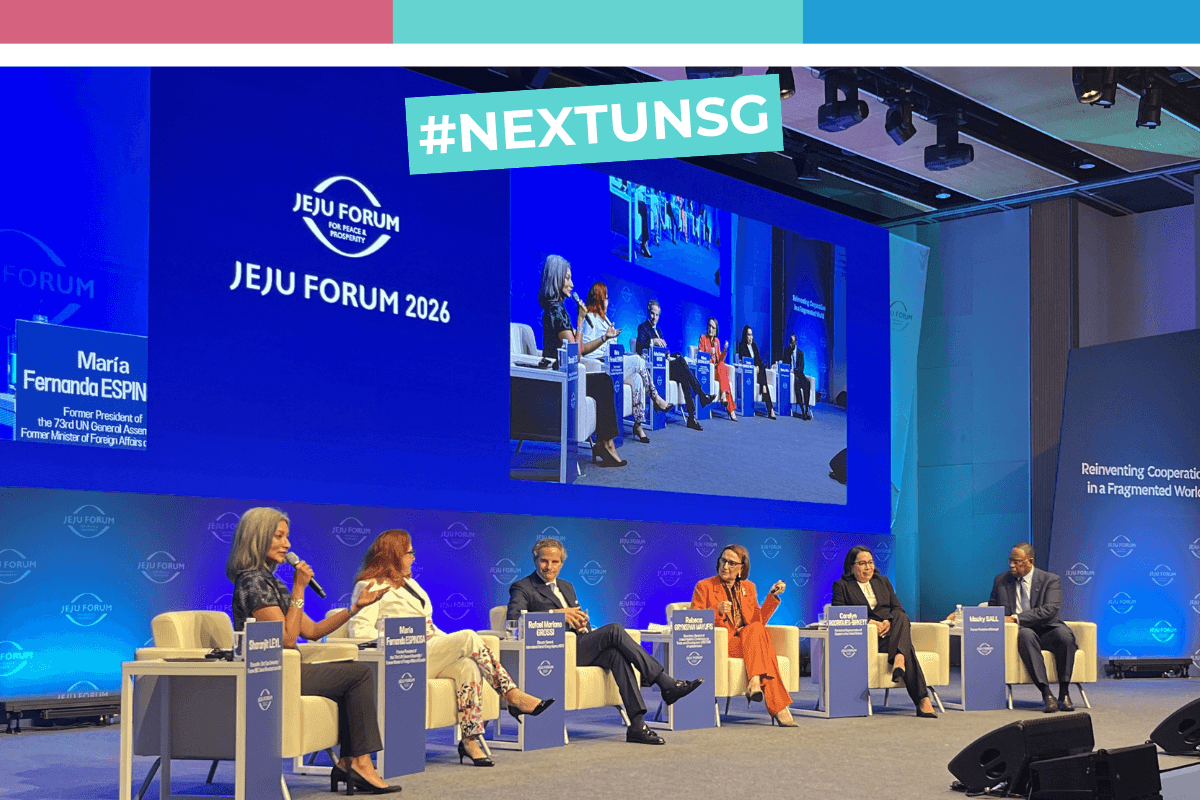
As the United Nations prepares to enter a new chapter of leadership, candidates for Secretary-General came together at the 21st Jeju Forum for Peace and Prosperity to share their visions for the future of multilateralism, global cooperation, and the United Nations itself. The historic public debate, co-organized by GWL Voices, the United Nations Foundation, the Ban Ki-moon Foundation For A Better Future, and the Jeju Peace Institute, marked another important step toward a more transparent and inclusive selection process for the world's highest multilateral office.
Building on the momentum of the first public debate held in Geneva earlier this month, the discussion underscored the critical importance of leadership capable of renewing confidence in multilateralism and delivering solutions that respond to people's needs.
Five candidates participated in person, with former President of Chile and former UN High Commissioner for Human Rights Michelle Bachelet joining via video message. Together, the candidates reflected on how the United Nations can remain relevant, effective, and representative in a rapidly changing world.
Former UN Secretary-General Ban Ki-moon, a son of the Republic of Korea and the eighth person to hold the office, opened the proceedings with a candid reflection on the weight of the role. Describing the moment as "one of the most consequential selections in the history of the United Nations," Ban Ki-moon acknowledged both the extraordinary difficulty of the position and the historic opportunity it represents. "One of you will walk side by side with the most dedicated people on earth," he told the candidates. "You will be the ones to ignite hope when the world needs it most."
Across three thematic rounds — reimagining multilateralism, peace and security, and the future of the UN for the next generation — the candidates offered substantive and at times strikingly candid visions for how they would lead the organization through a period of profound institutional strain and historic opportunity.
Reimagining Multilateralism
Across the discussion, candidates agreed that strengthening trust in international cooperation is essential to addressing today's global challenges. They highlighted the need for a more effective, accountable, and representative United Nations that can better respond to the realities of the 21st century.
On the question of reforming multilateralism, Espinosa called for rebuilding trust, closing what she described as the UN's largest-ever implementation gap, and strengthening accountability across the system. Grynspan argued that the UN must fundamentally change its culture, learning to partner with the private sector and civil society not merely for resources but to harness knowledge and capacity. Rodrigue-Birkett emphasized the need for evidence-based structural reform and the protection of delivery mechanisms that demonstrably reach people on the ground. Grossi underscored that while regional groupings like the G20 and BRICS reflect legitimate political realities, the UN remains the only truly universal platform capable of addressing global preoccupations. Sall said that an organization founded by 51 countries in 1945 is now expected to serve 193, which calls for a shift in paradigm: a fairer redistribution of access to capital markets, financial systems, and emerging technologies, including artificial intelligence.
The conversation explored institutional reform, partnerships with civil society and the private sector, equitable access to technology and finance, and the importance of ensuring that global governance structures reflect the diversity and aspirations of all Member States. The debate reinforced a shared recognition that multilateralism remains indispensable, but must evolve to meet contemporary challenges.
Peace, Security, and Prevention
Candidates also addressed the growing complexity of global conflicts and humanitarian crises, emphasizing prevention, diplomacy, and sustained engagement as key responsibilities of the next Secretary-General.
Espinosa argued that no conflict should be ranked above another, making the case for a Secretary-General defined by prevention, early engagement, and persistent presence. Grynspan drew on her direct experience negotiating the Black Sea Grain Initiative to illustrate when quiet diplomacy is essential; and visible and outspoken advocacy is the only responsible course. Grossi offered a sobering assessment of the nuclear landscape, warning that the gradual decline in nuclear arsenals has reversed and that countries previously sheltering under nuclear umbrellas are increasingly questioning that protection. Sall declined to assign a hierarchy to the world's conflicts, insisting that the Secretary-General's mandate demands equal attention to every crisis in which human beings suffer. In her video message, Bachelet framed her candidacy around the conviction that multilateralism is dialogue in practice, drawing on her dual experience as a head of state and as founding Executive Director of UN Women.
The discussion highlighted the need for leadership capable of building trust among Member States, fostering dialogue, and ensuring that no crisis is overlooked. Candidates stressed that peace, development, and human rights cannot be treated in isolation, but must be advanced together through a renewed commitment to international cooperation.
The United Nations and the Next Generation
A recurring theme throughout the debate was the need to reconnect the United Nations with younger generations. Candidates acknowledged that the institution must create more meaningful pathways for youth participation and leadership while ensuring that young people have a direct voice in shaping decisions on issues that will define their future, including artificial intelligence, climate action, and global governance.
On the future of the UN for young people, Grynspan revealed that only 4% of UN staff are currently under 30, calling for an immediate reopening of entry pathways. Espinosa argued for genuinely intergenerational teams as a matter of institutional effectiveness, not optics. Rodrigue-Birkett called for young people to be active shapers of AI governance frameworks, not onlookers. Grossi acknowledged frankly that the UN simply does not exist in the world of young people today, and that rebuilding that connection requires both better communication and concrete policy results they can see and feel. Sall identified education as the most overlooked and most consequential issue facing the next generation, and the essential foundation for everything else, including the capacity to participate meaningfully in an AI-driven world. Bachelet, in her video message, invoked UN Security Council Resolution 2250 on youth, peace and security, calling on the organization to treat young people as co-authors of global decisions, not observers, and reaffirming that peace, development, and human rights must be treated as a single, indivisible agenda.
The discussion reflected a broader understanding that the future legitimacy and effectiveness of the United Nations will depend on its ability to engage, empower, and represent the next generation of global citizens.
Advancing a More Transparent Selection Process
As the selection process for the next Secretary-General enters a critical phase, public debates such as those held in Geneva and Jeju are helping to bring unprecedented transparency and public engagement to a decision that affects people around the world.
For GWL Voices, this effort is part of a broader commitment to strengthening the legitimacy, inclusivity, and accountability of global governance. The organization continues to advocate for a selection process that reflects the principles the United Nations seeks to uphold—and for leadership that is representative of the world it serves.
With the High-Level Political Forum and the 81st session of the UN General Assembly on the horizon, the coming months will be decisive. The international community now has an opportunity not only to evaluate candidates' visions, but also to shape the future direction of multilateralism at a moment when effective global leadership has never been more important.