Action Agenda Analysis: Why it matters for women and girls
Share
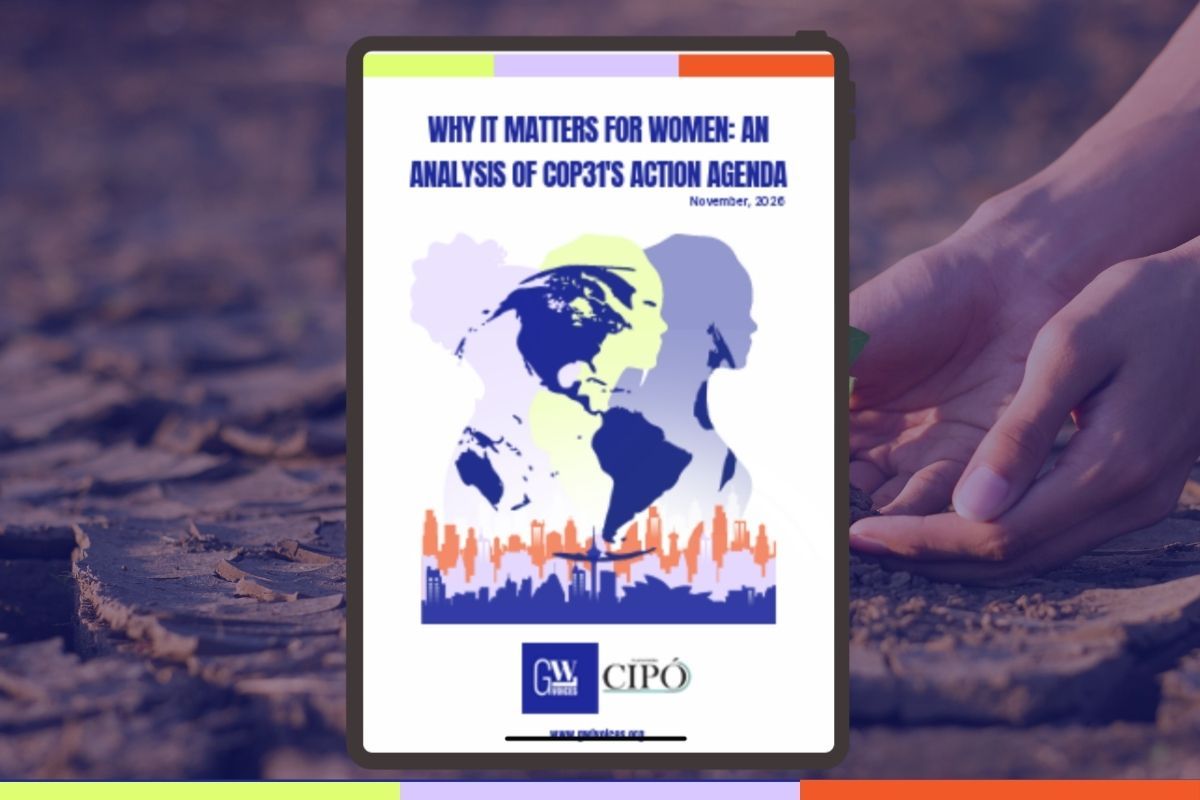
Action Agenda Analysis: Why it matters for women and girls, is a report developed by GWL Voices in collaboration with Plataforma CIPÓ ahead of COP31 in Antalya, Türkiye.
The Action Agenda is the voluntary side of the COP process, bringing together actors outside negotiation rooms, including civil society, cities, business, and academia, to implement climate solutions on the ground. The COP31 Action Agenda spans 10 themes, from zero-waste to health systems.
Our analysis found that the COP31 Action Agenda lacks references to gender equality across all but 1 of the 10 priority themes. Women appear explicitly in only one isolated case, under Food Security.
The analysis examines each of the Action Agenda’s ten priority themes. It identifies where gender perspectives are missing and how climate impacts and policies under each theme affect women and girls differently. Building on the recently adopted Belém Gender Action Plan, it draws on the latest data to make the gender dimensions of each priority theme visible.
Three main takeaways are:
- The disproportionate impacts women experience from the climate crisis stem from a range of structural inequalities. Climate action that does not address these overlapping inequalities runs the risk of building resilience for some, while reproducing harm to others.
- Women are not just victims, but unmissable agents of climate action, in food systems and beyond.
- Women’s equal representation and leadership - at all levels of climate governance - is an essential building block of inclusive and effective climate action.
Findings under each Action Agenda priority theme include
1. Zero Waste
Women are an essential part of those employed in the waste sector, yet women waste pickers tend to have less access to quality equipment than men, resulting in lower incomes and higher health risks.
2. Oceans and Seas
Globally, 2.9 billion women and girls live in countries highly or very highly exposed to climate and geophysical hazards. Yet globally, less than 12.5% of ministries in charge of the ocean are led by women.
3. Food Security (This Action Agenda priority is the only time women are mentioned in the COP31 Action Agenda – under finance for women farmers.)
Women represent more than 40 percent of the agricultural labor force in low- and middle-income countries, yet they face systemic exclusion from land titles, credit, extension services, and climate information. In 43 out of 49 countries with data, men are more likely than women to own land or have secure land rights.
Over one billion women and adolescent girls suffer from one or more forms of malnutrition. Climate shocks exacerbate these nutrition disparities by intensifying agricultural losses and driving up the cost of healthy diets.
4. Climate Resilient Cities
Buildings designed without a gender lens often consume more energy than predicted. One reason is that heating, ventilation, air-conditioning and insulation systems have historically been designed around the metabolic rate of the average adult man.
5. Finance and Institutional Change
Only 17% of finance ministers and 27% of environment ministers worldwide today are women. There is a structural pattern of underrepresentation of women in climate and financial institutions and decision-making.
6. Youth and Education
Girls provide 160 million more hours of unpaid care and domestic work each day than boys, often leading girls to drop out of school or enter early forced marriages.
Women account for less than a third of STEM graduates, which translates to reduced opportunities in the green job market.
7. Green Industrialization
While commitments to non-discrimination are widely included in industry standards or certifications, women often remain underrepresented. For example, they are only 14% of the workforce at Aluminium Stewardship Certificate-certified facilities.
8. Clean Energy Transition
As gender norms make women primarily responsible for cooking over polluting stoves and open fires, women and children account for most premature deaths from household air pollution.
Even in high-income settings, women-headed households are more likely to be energy poor in all but two EU Member States.
9. Synergies between the Rio Conventions
So far, participation targets across the 3 Conventions (biodiversity, climate, and desertification) have not translated into seats: men hold 60% of national focal points across the three conventions and 51 countries are represented only by men.
10. Dynamic and Resilient Health Systems
Evidence shows that extreme heat, wildfire smoke, and increased transmission of vector-borne diseases due to warming temperatures can harm women’s reproductive health and raise risks of pregnancy and birth complications.
This research was supported by a new cohort of rapporteurs from the Columbia Climate School, welcomed by Her Turn – GWL Voices’ youth initiative: Cassandra Kise, Sadie Eidson, Yanenowi Logan, Leela Riddle-Merritte, Madison Malthaner, Louise Brilliant and Divine Siam. Together with Nycolas Candido of Plataforma CIPÓ, and Evanna Corona, Climate consultant for GWL Voices, they helped build an evidence base for more inclusive, gender-responsive climate action.