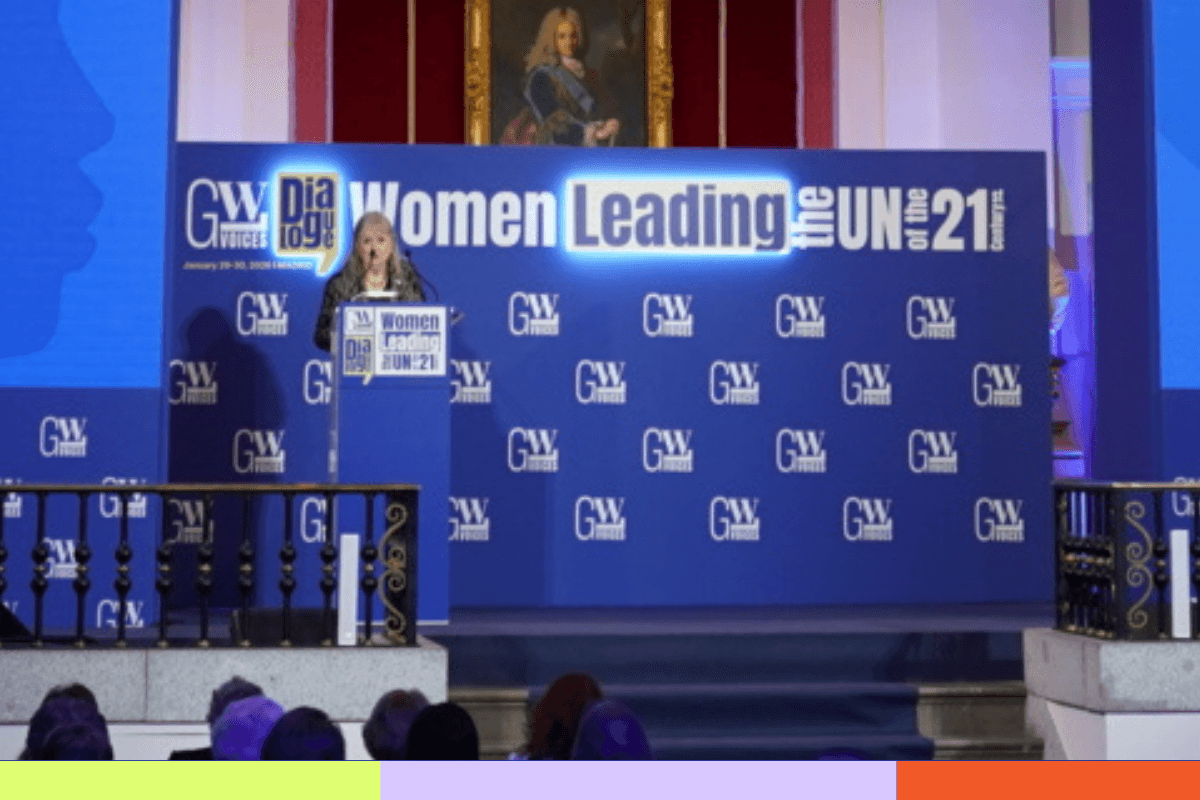
Welcoming Remarks of GWL Voices Dialogue 2026 by GWL Voices President Susana Malcorra
Share
Good morning, Su Majestad, authorities, colleagues, friends, and partners.
Let me begin by warmly welcoming you to this 2026 GWL Voices Dialogue. It is a real pleasure to see so many of you gathered here—members, partners, and friends—at a moment that is as consequential as it is challenging for the multilateral system and for the values that have guided our collective work for decades.
I will be candid from the outset: we meet at a difficult—indeed dangerous—time, when the lives and futures of people and planet are at serious risk. The global context has become markedly more fragmented, polarised, and unpredictable. Geopolitical tensions, protracted conflicts, democratic backsliding, and a growing disregard for agreed norms and international law are placing unprecedented strain on international cooperation. Multilateral institutions are under pressure—not only in terms of effectiveness, but also of legitimacy and trust.
The core premise of the UN Charter—that there can be no peace without human rights, no human rights without peace, and neither without development—is increasingly being questioned, including by some of those who helped shape that very framework. The international system was built on the understanding that restraint and self-restraint were in the interest of states. That understanding no longer holds.
Today, the use of force to acquire territory, control resources, or assert spheres of influence is justified under a variety of pretexts—historical entitlement, national defence, or national interest. Any excuse seems to suffice. The guardrails that once constrained behaviour have eroded.
At the same time, we are witnessing a concerted pushback against gender equality. Hard-won gains are being questioned, reframed, or openly contested. Anti-gender narratives are no longer marginal; they have entered mainstream political and multilateral spaces. Concepts such as “merit,” “efficiency,” or “national interest” are increasingly instrumentalised to resist gender-responsive approaches. Violence against women is rising—used as a weapon in conflict and persisting in peace—reminding us how fragile progress remains.
This is not an abstract diagnosis. It is something many of us encounter daily in capitals, in multilateral fora, in public discourse, and in legal, financial and policy setbacks. And it is precisely this context that makes our coming together today both necessary and urgent.
GWL Voices was created for moments like this.
From the outset, our proposition has been clear: women’s leadership is not symbolic, nor peripheral. It is a necessary condition for legitimate, effective, and responsive multilateralism. But we must also be honest: the international system, as it currently exists, is insufficient to address the scale and complexity of today’s challenges. Incremental adjustments will not be enough.
What is required is a willingness to rethink—and, where necessary, to reinvent—the way the international system functions. Not by discarding its foundational principles, but by reimagining institutions, processes, and leadership models so they are fit for purpose. Creating spaces for out-of-the-box thinking, experimentation, and candid reflection beyond formal negotiating constraints has become fundamental.
Over the past year, we have learned that progress is no longer linear; advancing change increasingly requires defending existing gains. We have also learned that evidence remains essential, but insufficient on its own. Data must be paired with narratives that speak to legitimacy, performance, and outcomes—narratives that resonate with people in their own language, not in the jargon of elites and bureaucracies. Above all, we have learned that collective action is our greatest strength.
This Dialogue is part of that effort.
This is not a conference, and it is not a negotiation. It is a space to acknowledge the shortcomings of the system—and our own collective failure to deliver on the promises made, beyond the actions of the major powers alone. It is a deliberately designed space for honest exchange, strategic alignment, and creative thinking across generations, regions, and experiences.
Its timing is particularly significant. We are entering a period that will shape the future of the international system in very concrete ways, including the process leading to the selection of the next United Nations Secretary-General. Our Madam Secretary-General campaign is not about a single individual; it is about principles—transparency, merit-based leadership, accountability, and the recognition that gender equality is integral to institutional credibility and effectiveness.
We are not naïve about the challenges ahead. We do not underestimate the resistance or the political constraints we face. But moments of inflection do not announce themselves politely; they demand clarity of purpose, creativity, and collective courage.
That is why representatives of younger generations are here with us—not as observers, but as essential contributors, bringing perspectives that are critical to shaping a more credible and hopeful future.
If not now, when should we bring our collective voice, experience, and leadership to the fore?
As we begin this Dialogue, I invite you to engage fully—to listen, to challenge, to think boldly, and to imagine beyond inherited frameworks. The conversations we have here matter, not because they will yield immediate answers, but because they help shape the alliances and strategies that will define our work in the months ahead.
Thank you for being here, and for the leadership you bring to this collective endeavour. I very much look forward to our discussions.