Women Leading the UN of the 21st Century: The Decalogue for Action
Share
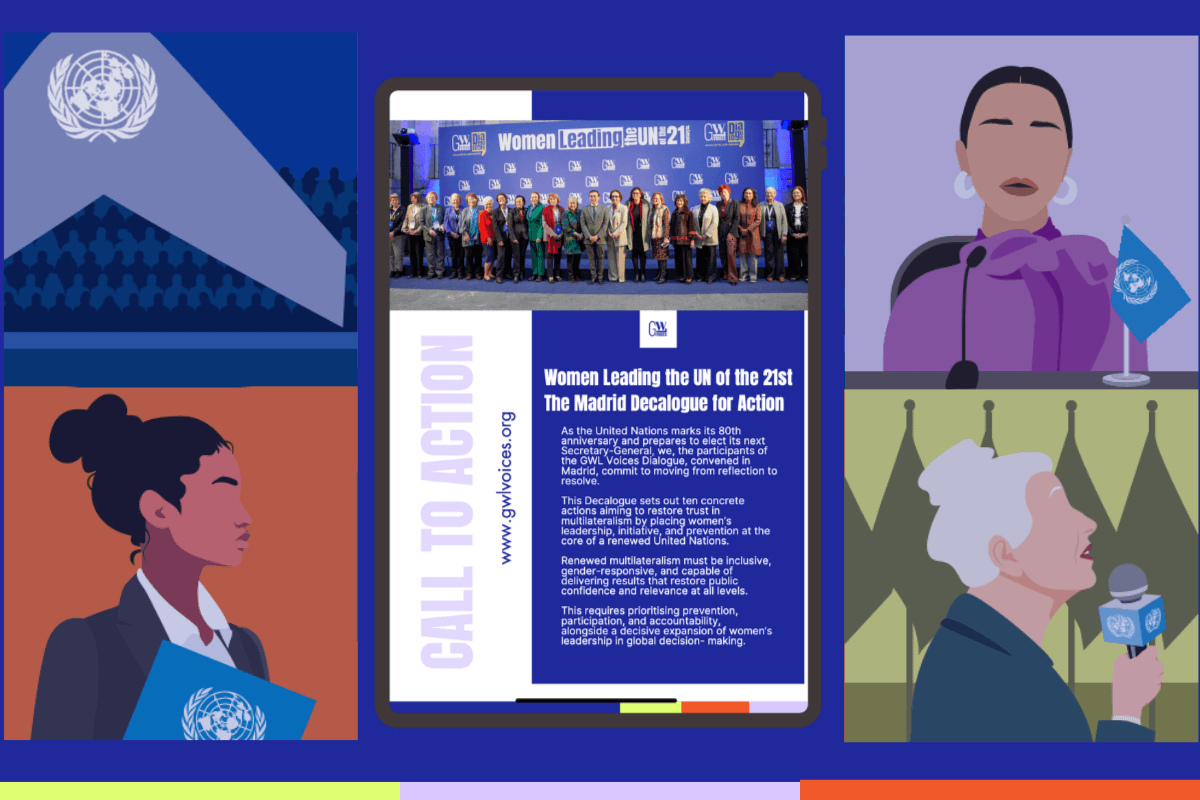
As the United Nations marks its 80th anniversary and prepares to elect its next Secretary-General, we, the participants of the GWL Voices Dialogue, convened in Madrid, commit to moving from reflection to resolve. This Decalogue sets out ten concrete actions aiming to restore trust in multilateralism by placing women’s leadership, initiative, and prevention at the core of a renewed United Nations.
Renewed multilateralism must be inclusive, gender-responsive, and capable of delivering results that restore public confidence and relevance at all levels. This requires prioritising prevention, participation, and accountability, alongside a decisive expansion of women’s leadership in global decision-making.
1. Uphold International Law, Multilateral Cooperation, and Effective Global Governance
These foundations are essential for peace, prosperity, and collective wellbeing. Their erosion undermines institutional legitimacy and the ability to address shared challenges. Restoring trust in multilateralism requires delivering tangible results on peace, inequalities, climate, and rights, with women leaders driving coherence across silos and upholding these shared principles. This requires creating new spaces for dialogue and innovation that challenge and adapt the existing architecture to the realities of the 21st century.
For the sake of our shared humanity, renewed global governance must be anchored in international law, human rights, and gender equality, without which multilateral cooperation cannot deliver peace, sustainable development, or wellbeing.
2. Reset Global Governance to Reflect a Multipolar World
Modernize decision-making structures to better integrate regional organizations, local governments, civil society, academia and the private sector, moving from centralized power toward a more networked, participatory, and gender-responsive multilateralism.
3. Place Women’s Leadership at the Center of UN Reform and the Reset of the International System
Women’s leadership and gender-responsive governance must be embedded as binding performance benchmarks across the international system, ensuring accountability, transparency, and meaningful participation in all decision-making bodies.
4. Deliver a Transparent, Merit-based, Gender Sensitive, UN Secretary-General Selection Process in 2026
Open hearings, clear selection criteria, and parity-based shortlists should be institutionalized. Member States should commit to appointing the UN’s first woman Secretary General.
5. Reposition Prevention and Women’s Leadership at the Heart of Peace and Security
Shift resources, mandates, and authority toward early warning, mediation, conflict prevention, and peacebuilding, ensuring women’s leadership in political missions, special envoys, and regional prevention architectures.
Women should also have an active role in peace processes, post-conflict reconciliation and stabilization.
This includes proactive action to combat all forms of violence against women, including in conflict settings, political life, and digital spaces, and to integrate gender-responsive approaches across peace, security, and climate-related risks.
6. Democratize Global Finance and Economic Governance
Accelerate reforms of international financial institutions to ensure legitimacy, effectiveness and women’s meaningful participation in executive boards, leadership pipelines, and economic decision-making. Commit to gender- responsive budgeting, taxation policies, and financial architecture reforms that address gender disparities.
Deepening inequalities threaten human security and undermine trust in multilateralism, making gender-responsive economic governance a core requirement for renewed global cooperation.
7. Link Climate, Peace, and Women’s Leadership as a Single Security Agenda
Climate action, adaptation, and climate finance must systematically integrate women and girls and conflict prevention, recognizing women as agents of resilience and transformation, not only as victims of crisis and conflict. Ensure women lead in shaping climate-security policies and locally informed solutions.
8. Translate global commitments into local power
Bridge multilateral agendas with local governance by investing and empowering women mayors, local intergenerational leaders, and city-level action as frontline implementers of peace, public services and rights so as to translate global commitments into local decision-making.
9. Protect and renew the Beijing legacy for a new geopolitical era
Beijing+30 should build on the broader legacy of Mexico, Cairo, and Beijing by moving beyond stocktaking toward protecting hard-won rights and advancing structural change adapted to today’s geopolitical, technological, and security realities.
10. Build a cross-generational alliance for the UN We Need
Institutionalize youth and emerging leaders’ participation—including young women and men—in reform debates, leadership pipelines, and accountability mechanisms to future-proof the multilateral system.
Madrid sends a clear message:
Inclusive, gender-responsive multilateralism is not only a matter of fairness but a prerequisite for legitimacy, effectiveness, and the common good of our shared humanity.
The future of multilateralism will not be restored through inertia but through innovation, renewed narratives, and updated governance designs. Women’s leadership, structural reform, and political courage are not optional, they are foundational. The legitimacy and effectiveness of the international system depend on translating these principles into concrete action, now.